Professional Korean interpreters available 24/7 by phone or by video to support your organization.
Why Korean Interpretation Matters
The Korean-speaking limited English proficient (LEP) population in the U.S. is over 570,000 individuals. As demand grows across healthcare, legal, and public services, qualified Korean interpreters are essential to clear communication, better outcomes, and equitable access.
570,000 LEP Individuals
Over 570,000 individuals in the United States depend on speaking Korean to access public services.
Compliance Requirements
Federal and state regulations, including Title VI, ACA Section 1557, and CLAS standards, require organizations to provide meaningful language access.
Interpreting Affects Outcomes
When language barriers go unaddressed, important details are missed. Korean interpreter services reduce risk and support informed decision-making.
On-Demand Korean Interpreting
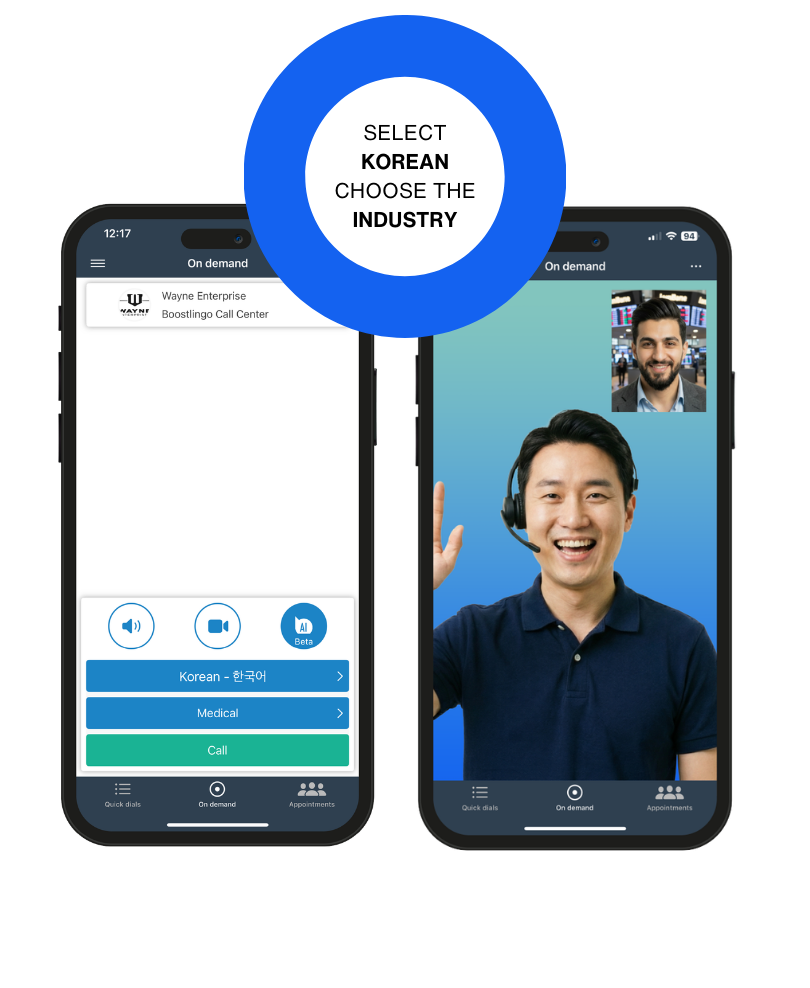
Boostlingo provides a quick and simple way to connect with qualified Korean interpreters whenever you need them. Here’s how it works:
Select Korean from the language menu in the Boostlingo app.
Choose your specialty: Medical, Legal, Community, or other industry domain.
Pick phone (OPI), video (VRI), or AI, and get connected to a professional interpreter in seconds.
No delays. No manual routing.
Just reliable, Korean interpreting for every workflow.
Choose the interpreting solution that fits your workflow and environment. Boostlingo provides on-demand access, blended pricing, and one unified platform to simplify language access and control costs.
Video Remote Interpreting (VRI)
Ideal for medical, legal, and education settings where visual cues matter. Secure, real-time video access.
Learn how Goshen Health consolidated all remote interpreting languages and scheduling into a single vendor.
“Across our system, we use VRI and OPI on our video devices so staff can connect with an interpreter at any time. Every patient care area has a device ready to use, and within a minute or less, they are speaking with an interpreter. The service has been excellent.”
Challenge Manufacturing
“Your live translation tool has been exceptionally valuable, helping our multilingual workforce communicate clearly and meet customer expectations in a regulated environment.”
Matthew Launiere, CPTD, Director of Learning and Development
Integrity Interpreting
“The thing that I LOVE love is that Boostlingo ii has remote capability.”
Rachel Matthews, Owner
Orthopedic Institute
“With Boostlingo, our Physicians hit their regulatory marks. They don’t have compliance knocking on the door and it gives them an opportunity to just treat their patients.”
Michelle R., Director of Compliance and Risk
Pro-Z.com
“The platform’s scalability is superb. Communication is seamless (both VRI and OPI) and updates keep coming out non-stop. The staff is super friendly!”
Enrique Manzo, Head of Interpreter Ops
Las Cruces Schools
“Knowing that there is now an interpretation service we can use and not have to fumble between piecing together what we can communicate has been wonderful.”
Ge Ann Kilgore, English Language Coordinator
Northern Nevada HOPES
“With Boostlingo, we’re able to connect with an interpreter for a majority of our languages in seconds. It’s just perfect from an operational perspective.”
Jerry Trigueros, VP of Patient Services
Looking for Korean Translation?
Korean interpreting and Korean translation are not the same. Interpreting handles real-time spoken conversations. Translation focuses on written documents and materials.
Can Connecting to an Interpreter be as Easy as Calling an Uber?
This free eBook explains why on-demand interpreting is a vital tool for serving Korean-speaking communities and how to evaluate vendors.
Korean FAQs
Am I legally required to provide a Korean interpreter?
Title VI of the Civil Rights Act and ACA Section 1557 requires federally funded organizations – like healthcare providers, courts, schools, and social services – to provide meaningful language access for individuals with Limited English Proficiency (LEP), including Korean speakers.
How many Korean speakers are limited English proficient (LEP) in the United States?
Around 570,000 Korean speakers in the United States are limited English proficient (LEP) according to a report completed by the Texas Tech University Health Services Center.
Where is Korean primarily spoken?
Korean is primarily spoken in South Korea and North Korea, and it is the native language of Korean people worldwide. While there are political and regional differences between North and South Korea, the Korean language itself is largely the same, with minor differences in vocabulary, spelling conventions, and usage that do not prevent mutual understanding.
There are also diaspora communities of Korean speakers throughout the United States, primarily in Los Angeles and New York City.
Is Korean similar to Japanese and Chinese?
No. Korean is not linguistically related to either Japanese or Chinese. Korean has its own grammar, sentence structure, and writing system, which is called Hangul. Chinese uses logographic characters, and Japanese combines multiple scripts. Although Korean vocabulary includes some historical Chinese loanwords, the languages are not mutually intelligible.
Is Korean similar to Thai?
No. Korean and Thai belong to entirely different language families and share no significant grammatical or structural similarities. They have different writing systems, sound patterns, and linguistic roots, and speakers of one cannot understand the other without study.
How do I become a Korean interpreter?
Becoming a Korean interpreter requires bilingual fluency, specialized interpreter training, and significant experience interpreting for your chosen industry. You can explore training, requirements, and opportunities on our
interpreters page.
Can you support Korean interpretation services for languages other than English?
Yes. Even though this page focuses on English ↔ Korean interpreting, Boostlingo’s global interpreter network supports more than 300 languages. This allows you to access interpreting services for other language pairs, such as Korean ↔ Mandarin, Korean ↔ Spanish, or Korean ↔ Cantonese.
Get to Know Boostlingo Interpreters
From War Zones to Diplomacy: Stories of a Bosnian Conference Interpreter, Darko Bartula
Most people would agree cookies make life better. For us, they help us make our site and marketing better. We'd like to use cookies to analyze our website's performance and personalize ads, but only if you accept. By using our website and our products, you agree to our use of cookies. Opt-out in our cookie policy!
Functional
Always active
The technical storage or access is strictly necessary for the legitimate purpose of enabling the use of a specific service explicitly requested by the subscriber or user, or for the sole purpose of carrying out the transmission of a communication over an electronic communications network.
Preferences
The technical storage or access is necessary for the legitimate purpose of storing preferences that are not requested by the subscriber or user.
Statistics
The technical storage or access that is used exclusively for statistical purposes.The technical storage or access that is used exclusively for anonymous statistical purposes. Without a subpoena, voluntary compliance on the part of your Internet Service Provider, or additional records from a third party, information stored or retrieved for this purpose alone cannot usually be used to identify you.
Marketing
The technical storage or access is required to create user profiles to send advertising, or to track the user on a website or across several websites for similar marketing purposes.
Most people would agree cookies make life better. For us, they help us make our site and marketing better. We'd like to use cookies to analyze our website's performance and personalize ads, but only if you accept. By using our website and our products, you agree to our use of cookies.
Functional
Always active
The technical storage or access is strictly necessary for the legitimate purpose of enabling the use of a specific service explicitly requested by the subscriber or user, or for the sole purpose of carrying out the transmission of a communication over an electronic communications network.
Preferences
The technical storage or access is necessary for the legitimate purpose of storing preferences that are not requested by the subscriber or user.
Statistics
The technical storage or access that is used exclusively for statistical purposes.The technical storage or access that is used exclusively for anonymous statistical purposes. Without a subpoena, voluntary compliance on the part of your Internet Service Provider, or additional records from a third party, information stored or retrieved for this purpose alone cannot usually be used to identify you.
Marketing
The technical storage or access is required to create user profiles to send advertising, or to track the user on a website or across several websites for similar marketing purposes.