

Explore
6 min read
The Cost of Translation Errors in Global Business
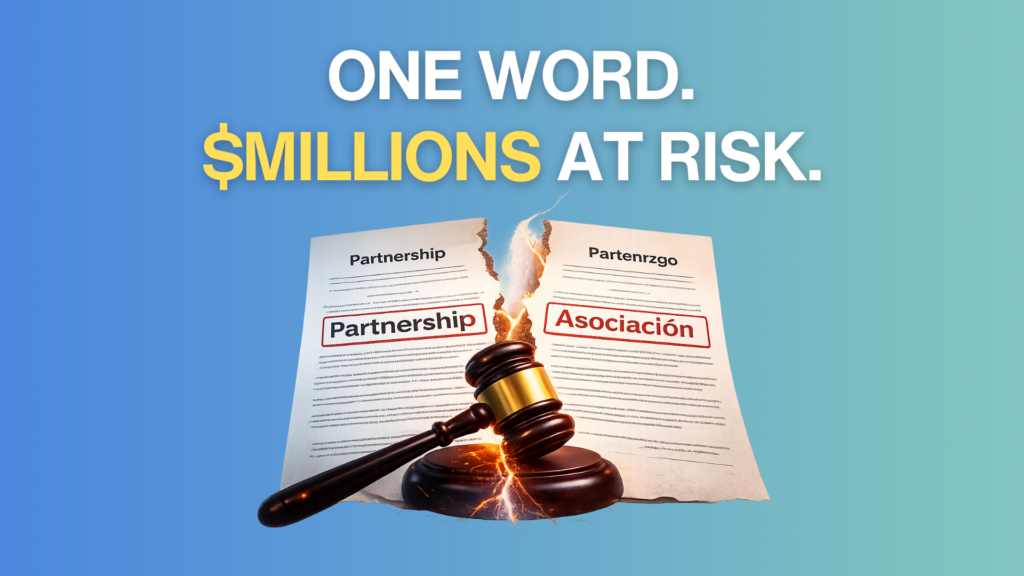
In global business, a single word can trigger a lawsuit.
For Western Bagel, conflicting English and Spanish versions of an arbitration agreement created confusion over whether it was binding. Instead of resolving the employment dispute, both parties ended up fighting over enforceability in court, spending time and money on procedural matters before reaching a resolution.
That’s the cost of translation errors in global business. Not embarrassment, but litigation.
This article breaks down how translation errors occur, highlights documented examples of international disputes, and explains how professional translation safeguards global operations.
Translation Errors That Triggered International Disputes
This risk is not theoretical. There are documented cases where international business translation blunders directly shaped legal outcomes or escalated conflict, and here are some of them:
The Legal Battle Between Kellogg Brown & Root and Constructora Hostotipaquillo
In a dispute tied to an $18 billion Mexican refinery project, one Spanish phrase became central: “convenio de asociación.” Constructora Hostotipaquillo (Hosto) argued it created a joint venture with fiduciary duties, while Kellogg Brown & Root (KBR) argued the parties were merely associated.
That difference mattered. A joint venture can expand liability and impose fiduciary obligations, and the case eventually went to a county jury.
In the end, KBR won. But both sides spent years and substantial legal fees arguing over the meaning of one translated phrase.
Shanghai Maritime Court Shipping Contract Dispute
One of the most popular cases of business mistranslation between two international companies, the Shanghai Maritime Court Shipping case, involved a shipping contract originally drafted in English and later translated into Chinese.
During litigation, it became abundantly clear that key technical shipping terms had been mistranslated in the Chinese version.
In this case, two terms were mistranslated:
- “Drydocking” was translated as “tank washing.”
- “Except fuel used for domestic service” was translated as “except fuel used for domestic flights.”
Those are not minor differences. They affect maintenance obligations, fuel allocation, and cost responsibility. The court had to rely on expert translators to reconstruct intent before it could even begin to assess liability.
This case is frequently cited as an example of how technical mistranslation in cross-border contracts can distort contractual obligations and significantly increase commercial risk and expenses.
Ramos v. Westlake Services, LLC (2015)
In Ramos v. Westlake Services, the issue was omission rather than mistranslation. Alfredo Ramos, a Spanish-speaking customer, did not receive a translated version of the arbitration clause.
The trial court then denied Westlake’s motion to compel arbitration, affirming the Court of Appeal’s decision that Ramos did not receive a Spanish translation of the arbitration clause included in the English version of the contract.
While this case isn’t exactly a mistranslation, it highlights the importance of language translation in any official document, especially in legal agreements.
Besides litigation costs, delays, and exposure to class claim dynamics, this oversight also led to a loss of a key risk-control mechanism, which is arbitration, and forced the dispute into court.
Where the Financial Damages Show Up
When mistranslation touches enforceable documents, the damage typically appears in these three areas.
- Compliance Risk. If translated contracts change cancellation rights, warranty terms, pricing language, or dispute-resolution provisions, regulators may intervene, and companies may face penalties.
- Dispute Exposure. Conflicting language versions invite litigation, forcing courts to reconstruct intent and involving expert witnesses.
- Revenue Loss. Delayed projects, renegotiated deals, strained partnerships, and lost trust all lead to significant revenue losses.
Mistranslation creates uncertainty. And in international business, uncertainty is expensive.
Why Translation Errors Happen in International Business
While many assume contract translation is simply about swapping words between languages, the reality is far more complex.
It requires an understanding of how contractual concepts function within each jurisdiction, which is why technical translation services play a critical role in high-stakes business documentation: the subtlest shift in wording can alter payment deadlines, shift risk distribution, or affect enforceability.
That risk increases when companies:
- Rely on non-specialists
- Skip legal review
- Treat translations as “informational only.”
- Push high-stakes contracts through automation without human oversight
In recent years, AI translation tools have made achieving speed and scale easier. For internal documents or low-risk content, that can work well.
But legally binding contracts are different. They depend on context, defined terms, and jurisdiction-specific meaning. When AI-generated language goes unchecked, subtle errors can slip through. Those errors rarely show up immediately and only surface during disputes.
And by then, it’s already become expensive.
AI vs Human Expertise in Translation
For global business, the conversation stopped being “AI vs human translation” long ago. The more appropriate approach is to ask what level of risk a document carries.
AI-powered translation works for internal emails or high-volume content where precision is not the primary focus. But a cross-border supply agreement is not an internal memo. A foreign-language consumer contract is not marketing copy.
High-risk documents require subject-matter expertise and structured review.
In these environments, it’s not a matter of if artificial intelligence will introduce ambiguity; it’s a matter of when.
Translation as a Tiered Solution
When it comes to translation, there’s no such thing as a “one-size-fits-all” answer. That’s why many modern language service providers now provide translation as a tiered solution.
- AI Translation – Fast, affordable for low-risk content
- AI Translation with Human Review – Fast, more cost-effective with safeguards for medium-risk content
- Human Translation (ex., Document Translation) – Multi-step, certified translation done by humans for high-risk content
This approach gives businesses the opportunity to choose the level of human oversight that best suits their needs. Low-risk content may require light post-editing, but regulated documentation, contract translation, or compliance-heavy materials will require subject-matter expert linguists and multi-stage reviews.
The key isn’t choosing between speed and quality. It’s aligning translation quality with business risk.
AI can improve efficiency. Humans protect enforceability.
Why Professional Translation Reduces Risks and Protects Revenue
The advantages of working with professional translators for business documents extend beyond linguistic accuracy. Experienced legal and commercial linguists understand subject matter terminology and jurisdictional differences, helping you avoid higher legal costs or lost arbitration rights.
These structured quality assurance processes, terminology management systems, and multi-stage review workflows significantly reduce risk.
The benefits professional translation services bring for international businesses are easiest to see when you compare them to the alternative. Disputes avoided, compliance issues prevented, and an enforceable contract across languages all have measurable value.
Stop asking how much money translation costs and instead see the value of what accurate translation can protect.
How Boostlingo Helps Prevent Costly Errors
Translation errors damage trust and increase liability. Global businesses cannot afford either.
Boostlingo supports legal and business teams with scalable translation services designed for accuracy and security. Through qualified linguists, structured review processes, and technology-assisted efficiency, organizations reduce ambiguity before it becomes a dispute.
Because in international business, prevention costs less than litigation.

![A laptop streaming a live keynote event, showing a speaker on stage with large real-time captions displayed across the bottom of the screen that read: “[Moderator] Welcome to our keynote event. Captioners convert spoken content into clear text in real time.”](https://boostlingo.com/wp-content/uploads/2026/03/BLOG-Featured-Image-2.png)
