2026 Report
The State of Interpreting Technology
The secret to making language access easier for the people doing the work is reliable performance and orchestration.

In the Report
Signup for our newsletter
Managing interpreting is hard. Boostlingo makes it easier.

Foreword
Interpreting technology is already hybrid, but operations haven't caught up.
Across the industry, language access is being delivered through a mix of phone, video, onsite interpreting, bilingual staff, and, increasingly, AI.
That shift has expanded access, but it has also made language access harder to coordinate and manage consistently.
Our survey of 370+ stakeholders across healthcare, language services, nonprofit, and other sectors shows: the market doesn’t operate around a single modality.
- The average organization uses 2.3 modalities, with phone + video as the most common pair (44.3%).
- 52.1% of measurable on-demand remote interactions connect in under a minute, suggesting that fast access is becoming more common.
- 50% of respondents still reported an encounter with a limited English proficient (LEP) individual without an interpreter when one was needed.
That tension runs through this report.
Interpreting access has expanded, but it’s not as reliable as it should be yet.
High or unpredictable costs continue to pressure teams. Inconsistent quality creates operational friction. And manual work still holds too many workflows together.
Now AI is entering the market too, adding another layer for organizations to evaluate and manage.
The future of interpreting technology will not be defined by a single modality. It will be defined by how well organizations orchestrate all of them together.
This report looks beneath top-line adoption to show how interpreting works day-to-day, where the system still breaks down, and what more mature operations will require next.
Introduction + Key Findings
Boostlingo was founded in 2016 to solve remote interpreting delivery. Since then, we’ve gained 3,500 customers and become a leader in interpreting technology.
We run an annual survey of the market on interpreting technology, from AI adoption to healthcare delivery. For 2026, we widened the lens to the full interpreting technology landscape to better understand how language access is being delivered today, and we’re making the findings directly accessible.
No form, no download – just data that can be shared widely and put to use.
What we found wasn’t a market choosing between old and new models. It was a market that’s already hybrid and operationally uneven.
Here’s a quick look at the key findings:
The average organization uses 2.3 modalities, making hybrid interpreting the norm.
50% said their organization had interacted with an LEP individual without an interpreter when one was needed.
53.8% said inconsistent interpreter quality has a moderate to severe impact on operations.
High costs (34%), inconsistent interpreter quality (31.9%), and admin burden (31.3%) are the top challenges.
52.1% reportedly connect to an interpreter in under a minute, while 10.4% take more than three minutes.
16.8% are currently using AI interpreting, while 15.9% are evaluating it.
While cost, inconsistent quality, and admin burden are long-standing challenges in interpreting, our findings point to a new one: orchestrating multiple modalities. In practice, that means turning multiple interpreting channels into a system that is visible, reliable, scalable, and manageable in real operations.
“Ultimately, the differentiator will be orchestration. Organizations will require AI-driven platforms with context-aware orchestration layers that can dynamically align the right modality to the specific use case. In this model, hybrid operations are not just a transitional state but the operating standard – enabling language service companies and enterprises to optimize for quality, cost, and efficiency while delivering better overall outcomes. “
Bryan Forrester, Co-Founder and Chief Executive Officer at Boostlingo
The Language Access Gap
- Interpreter shortages are widespread, driven by limited supply, fragile training pipelines, and workforce churn.
- 50% report unmet interpreter need, even in high-frequency environments.
- 31.3% cite coordination as a top challenge, reflecting the difficulty of managing interpreting workflows.
The Interpreter Shortage
As demand for interpreting services rises and interpreter capacity remains strained, the interpreting gap stays wide.
Interpreter shortages are already documented in parts of the market. In state courts, for example, Ohio reports a shortage of qualified court interpreters, with demand having tripled since 2014.
Interpreter shortages are also a recurring issue in ASL access, where the limited supply of qualified ASL interpreters struggles to meet the demand.
“What’s driving interpreter shortages right now isn’t just demand. It’s a structural imbalance in the market.
What’s often missed is that workforce shortages are not just about supply, they’re about sustainability. Rates for on-demand interpreters are under pressure, even as demand increases. That creates churn, discourages entry into the profession, and weakens the long-term pipeline. So the shortage is not a temporary gap. It’s a signal that the current economic model isn’t stable.”
Katharine Allen, Director of Language Industry Learning at Boostlingo
By contrast, healthcare literature often points not to a nationwide statistic of interpreter shortage, but to underuse, access barriers, and insufficient use of professional interpreters even when services are reportedly available.
The research suggests that language-service lapses remain a serious problem in high-risk settings, where miscommunication, delay, and inadequate interpretation can directly affect care, due process, and access to essential services.
Our survey suggests that the core interpreting gap is no longer just whether interpreters are available, but whether they can be delivered reliably in practice. And that gap shows up in at least three ways: access at the point of need, visibility into performance, and coordination across workflows.
The Interpreter Access Gap
50% of respondents said their organization had interacted with an LEP individual without an interpreter when one was needed.
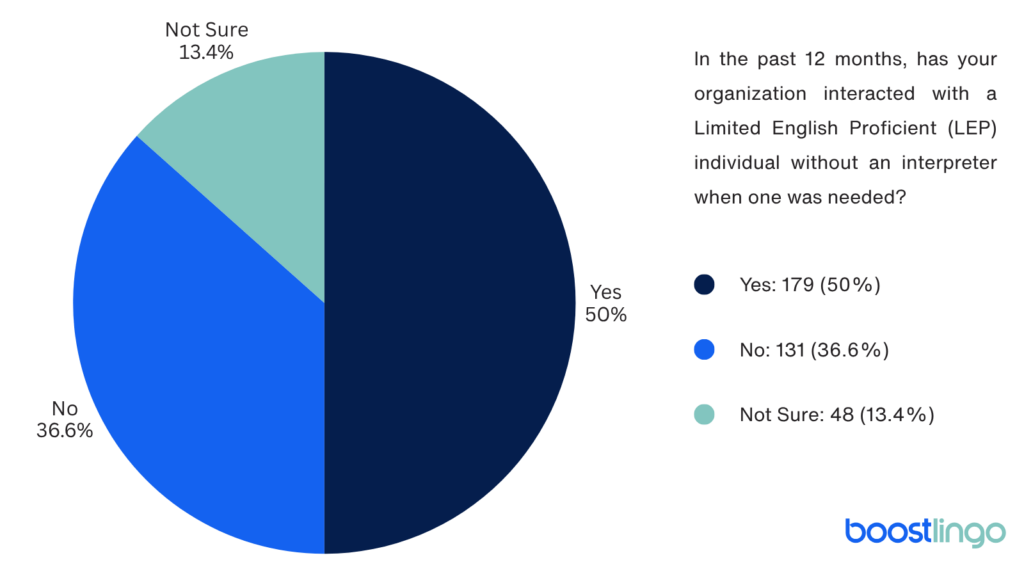
This wasn’t limited to low-demand environments. Among them:
- 45.3% cited needing interpreting services at least daily.
- 25.1% said they needed it weekly.
This access gap isn’t a new phenomenon:
Education Interpreting
Report 2025:
57% worked with an LEP student or parent without an interpreter.
Healthcare Interpreting
Report 2025:
50% had to treat LEP patients without an interpreter.
But here’s what makes this finding significant: The access gap isn’t limited to organizations with no interpreting infrastructure in place. It appears just as often in organizations already using multiple modalities.
Among respondents who reported LEP client encounters without an interpreter:
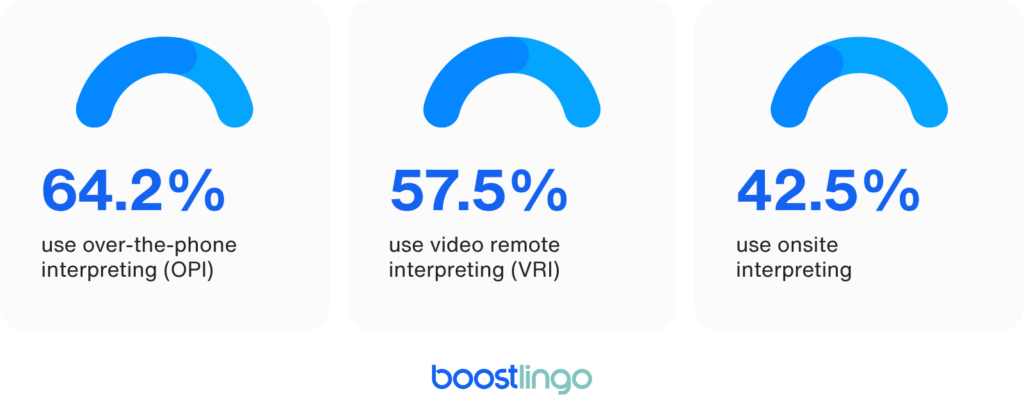
In other words, organizations reporting access failures already have multiple ways to connect to available interpreters. The issue doesn’t stem solely from demand or modality availability. It stems from whether interpreting services can be reliably accessed at the exact moment it is needed.
This is the interpreter access gap: the distance between having different ways to access interpreting and having them work when it matters.
The Visibility Gap
Access is only one part of the problem. For many organizations, the interpreting gap also shows up in what they can and cannot see when it comes to quality.
The survey data points to a clear issue. 31.3% of respondents cite inconsistent quality as a top challenge, making it one of the most common operational issues in interpreting today. At the same time, 82% report that quality issues have an impact on operations, affecting outcomes, efficiency, and trust in the system.
Despite this, quality is not consistently measured or surfaced across interpreting.
In most organizations, interpreting quality is still evaluated through partial visibility. A subset of interactions may be reviewed. This makes it difficult to identify patterns, compare performance across modalities, or intervene before issues escalate.
The challenge is compounded by how quality is defined.
Interpreting quality is not just accuracy. It includes:
- Completeness
- Clarity
- Flow of conversation
- Professional conduct
- Technical performance
Without structured measurement across these dimensions, quality becomes difficult to track at scale.
This creates a gap between what organizations experience and what they can manage. Teams may feel the impact of poor quality in the form of delays, rework, or risk, but lack the data needed to diagnose root causes or improve performance consistently.
If the access gap reflects breakdowns at the point of need, the visibility gap reflects limited insight into whether interpreting services are working as intended.
In much of the market, quality is experienced day to day, but not fully measurable.
The Orchestration Gap
The third gap is the one the market hasn’t named yet, but it’s the one that explains why organizations with “modern” interpreting systems still struggle with reliability.
31.3% of respondents said manual coordination is a top challenge.
Here’s what’s happening: first, organizations accessed onsite interpreters and bilingual staff, then adopted phone interpreting to solve onsite scheduling challenges. Then they added video interpreting for visual context. And now, AI for overflow.
Each addition was rational in isolation.
But each new modality adds a new decision point, a new workflow, a new device, and a new failure mode. Staff must now:
- Decide which modality to use (often without clear use policies)
- Navigate multiple apps, devices, or phone numbers
- Coordinate across systems that don’t talk to each other
- Troubleshoot when the “primary” option fails
- Document across disconnected platforms
This burden is especially pronounced in onsite-heavy environments, with 44% of onsite-heavy models reporting significant or excessive burden. But it seems the problem extends beyond these types of workflows as well.
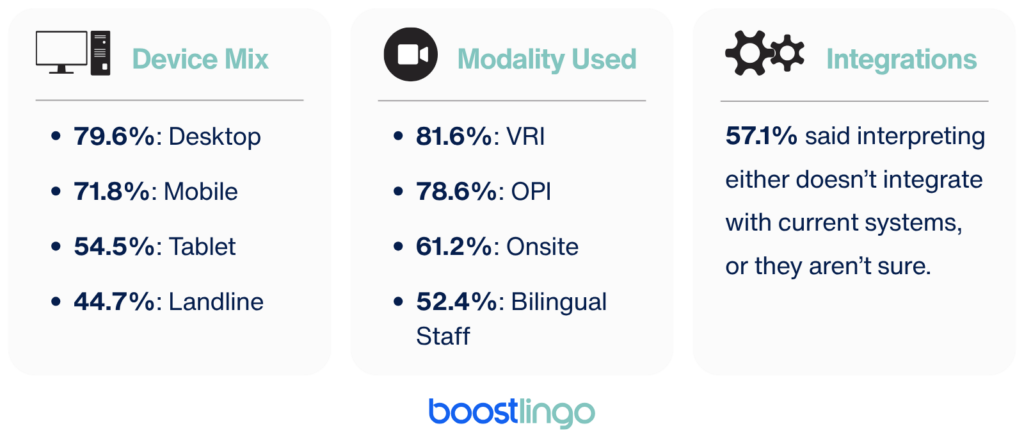
Among the 31.3% respondents that cited manual coordination as a challenge:
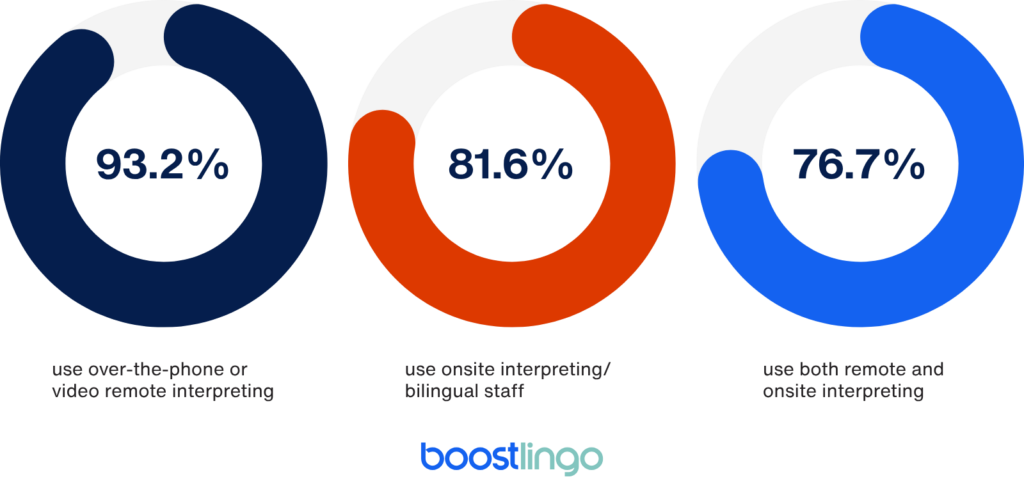
The same group also spans a broad device mix, including desktops/laptops, mobile phones, tablets, and landlines, suggesting that staff are often managing interpreting across fragmented channels rather than within a single system.
Where the access gap is about reaching an interpreter, and the visibility gap is about understanding performance, the orchestration gap is about managing complexity across channels, staff, and workflows in real time.
The challenge is no longer just making interpreting services available, but coordinating demand, modality, workflow, and staff at scale.
“The market is not shifting toward AI or human, it is shifting toward systems that decide when to use each and orchestrate them in real time. Hybrid is already here, the gap is intelligent routing, seamless rollover, AI as part of fulfilment but also consistent quality measurement across every modality.”
Brian D’Agostino, Co-Founder and Chief Product Officer at Boostlingo
Interpreting Delivery Today
- The average organization uses 2.3 interpreting modalities.
- Remote delivery is fragmented across devices: 57.6% mobile, 51.5% desktop, 48.6% tablet, 33.1% landline.
- Integration remains shallow: only 40.5% report integration, often limited to video tools rather than core workflows.
- 46.8% of organizations rely on onsite interpreting as the standard for high-risk interactions.
To better understand how these gaps show up in day-to-day operations, we asked respondents about how interpreting is delivered today, which devices and modalities they use, and how well interpreting connects with their existing systems.
What the data shows is that most hybrid systems are more fragmented, more manual, and less integrated than surface-level labels suggest.
Interpreting Modalities Used
At a high level, the most common modalities used today are:
The least being:
- 10.3% — AI Interpreting
13 respondents answered, “Other,” listing family members, ASL interpreters, and free online services such as Google Translate.
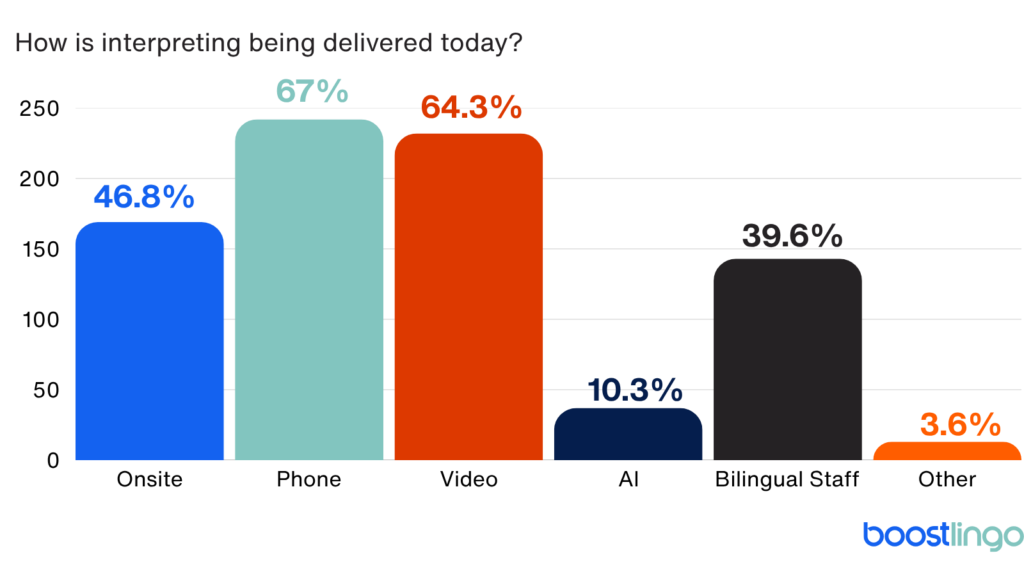
Looking closely, the survey suggests that interpreting is rarely delivered through a single modality.
Across respondents, the average organization uses 2.3 modalities, and the survey recorded 29 distinct modality combinations.
The most common exact mix among respondents was a 3-modality combination: onsite + phone + video (13.6%), followed by only phone + video (11.9%).
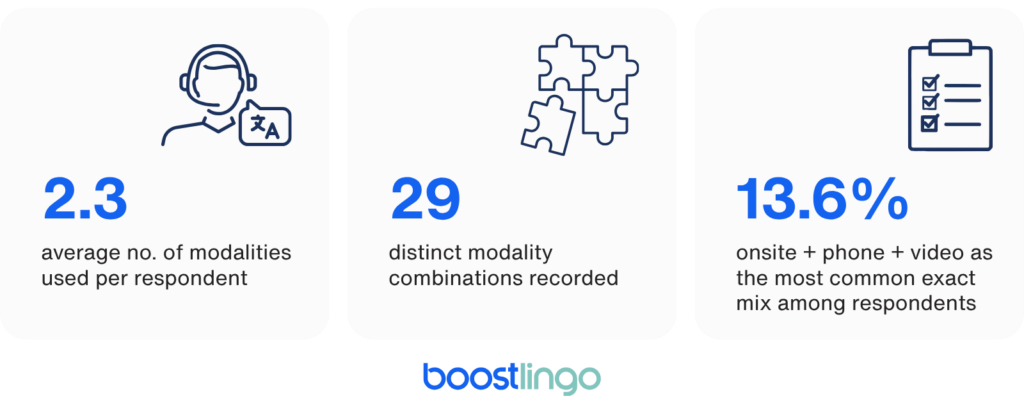
The most common co-occurring modality pairs were:
- Phone + video (44.3%)
- Onsite + video (33.5%)
- Onsite + phone (30.7%)
That pattern suggests that hybrid interpreting is already the norm. High-level reporting may imply a “primary” modality, but teams often use multiple ways to access interpreting.
But “multimodal” can mean two very different things:
- A coordinated system that routes intelligently between channels
- A collection of disconnected tools that staff must navigate manually
The data suggests some are closer to the second model than the first.
Interpreting Device Usage
That same complexity shows up in the device layer: most organizations aren’t relying on a single infrastructure to connect with interpreters, but a mix of tools and endpoints.
The most widely used devices were:
- Mobile phones (57.6%)
- Desktop or laptop computer (51.5%)
- Tablet (48.6%)
- Landline (33.1%)
- Other devices (10.5%), such as onsite booth-and-system setups, headphones, transmitters and bidule interpreting devices.
Usage intensity adds more context.
| Device Usage Distribution for Interpreting Interactions | |||||
| Device | None | 1-25% | 26-50% | 51-75% | 76-100% |
| Landline Phones | 107 | 71 | 33 | 31 | 30 |
| Mobile Phones | 59 | 75 | 63 | 46 | 48 |
| Desktop or Laptops | 51 | 47 | 54 | 61 | 90 |
| Tablets | 88 | 64 | 37 | 38 | 48 |
Desktop and laptop computers were the most embedded device overall, with 90 respondents saying they account for 76% – 100% of interpreting interactions.
Tablets, on the other hand, were more concentrated in lower-use bands, suggesting they are more often a supplementary device than a primary platform.
And while landlines may be seen as legacy infrastructure, they have not disappeared: among respondents, 30 said landlines still account for 76% – 100% of interpreting interactions.
This data suggests that phone interpreting is no longer tied to just landline. Instead, its being delivered across desktops, mobiles, tablets, landlines, and specialized equipment at once.
While this can increase flexibility, it also introduces operational fragmentation. Each device type brings:
- Different user experiences and training requirements
- Different failure modes and troubleshooting needs
- Different integration capabilities with existing systems
- Different cost and management overhead
Device proliferation without standardization introduces the same challenge as modality proliferation: more options, but harder to manage.
The Reality of Interpreting Integrations
- 40.5% said interpreting integrations work with their current systems.
- 34.6% said they don’t.
- 24.9% were not sure.
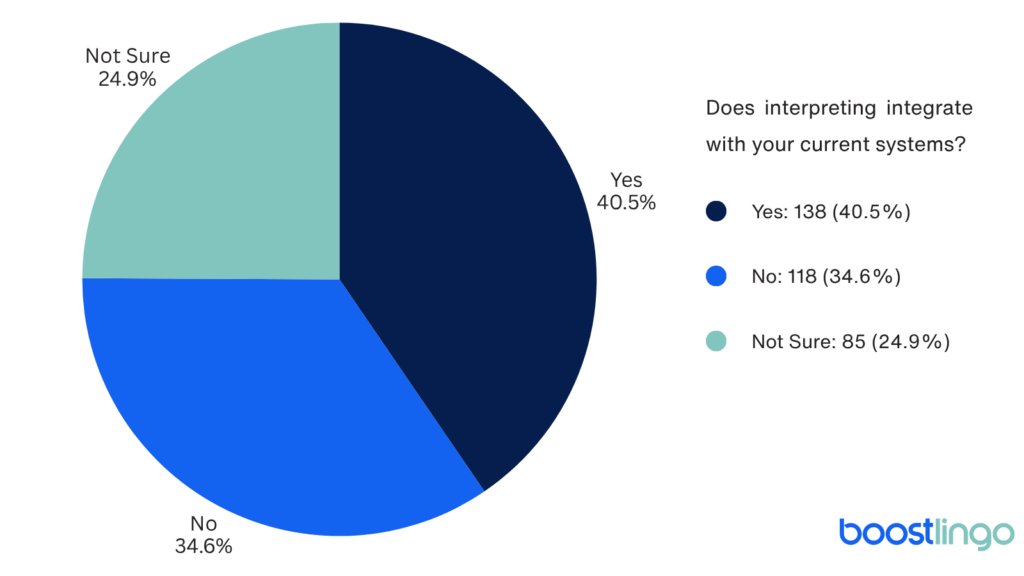
At first glance, these numbers seem encouraging: many organizations appear to be using integrations that connect with the platforms they already rely on.
However, when respondents described what those integrations were, the answers were often relatively lightweight. Many named video conferencing tools such as Zoom, Microsoft Teams, and Google Meet. Far fewer cited deeper workflow systems such as EHRs, Epic, and Citrix.
That isn’t to say that video conferencing integration is unimportant. For some organizations, it’s likely the primary environment where interpreting happens, and that level of integration may be enough.
At the same time, the market has evolved. Integration with video conferencing tools is increasingly table stakes, not the endpoint. As interpreting workflows become more hybrid and operationally complex, the bar is rising.
More enterprises will need solutions that go beyond surface-level connectivity and support stronger orchestration across scheduling, documentation, routing, care delivery, billing, and other day-to-day workflows.
It might be safer to say that connectivity is now more common, while true workflow integration still remains much less so.
The difference:
- Connectivity = “We can launch an interpreter session from within Zoom.”
- Integration = “Interpreter requests flow through our scheduling system, sessions are documented in the EHR, and performance data feeds into our quality dashboards.”
The Role of Onsite Interpreting
Remote interpreting may be the operational backbone, but onsite interpreting remains a core part of the system.
In the survey, 46.8% of respondents report using onsite interpreting, making it one of the most widely used modalities. It continues to play a role in interactions that require physical presence, context, or trust.
But onsite is rarely used alone. Among onsite users:
- 71.6% also use video
- 65.7% use phone
The most common setup is onsite + phone + video, pointing to a blended model rather than a single-channel approach.
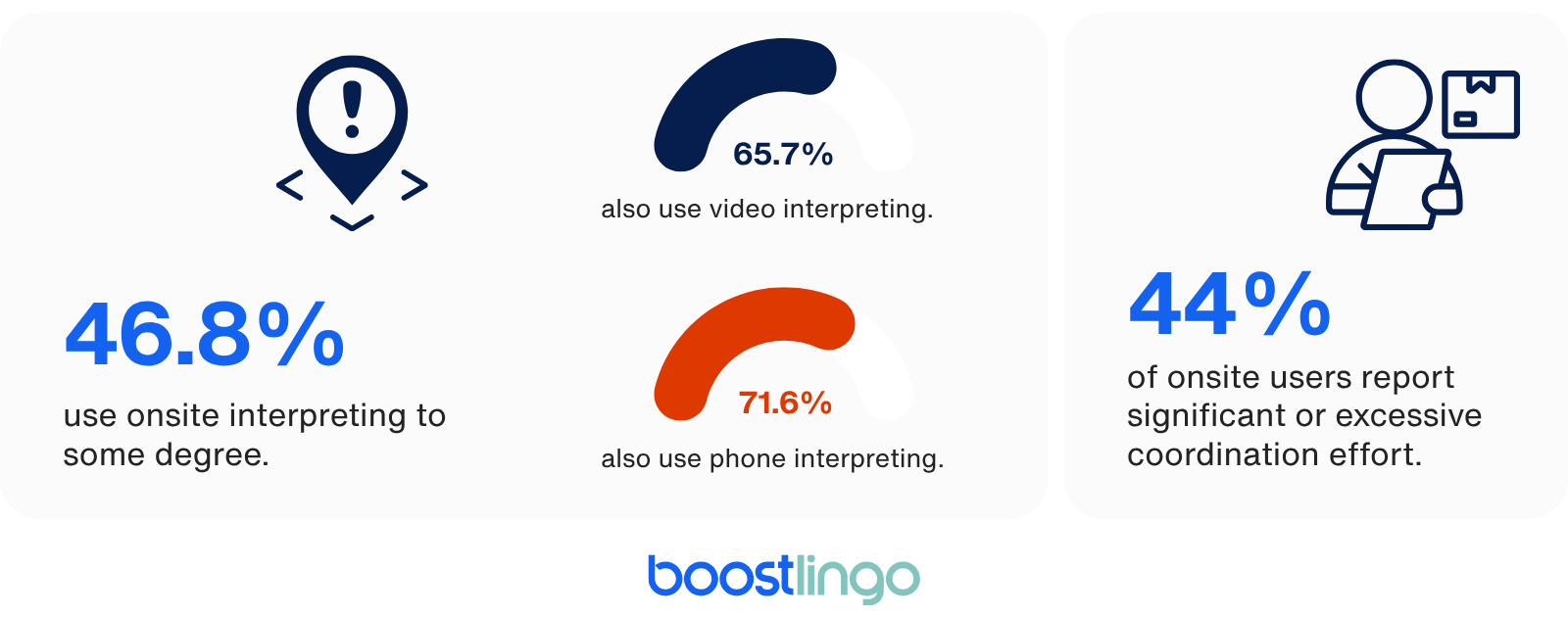
Onsite is also less likely to dominate volume. Most organizations use it selectively, while phone and video account for the majority of interactions.
This reflects a shift in role, rather than a decline in quality.
While onsite interpreting is no longer the default, it remains the benchmark for quality. It’s the highest-trust option within a broader hybrid system that must now balance cost, speed, and coordination.
Onsite interpreting is typically the most resource-intensive modality. With respondents reporting high cost pressures, many organizations appear to reserve it for higher-need scenarios and rely on remote channels for scale.
This introduces trade-offs. Onsite-heavy environments rely more on manual coordination and report greater operational burden: 44% report significant or excessive coordination effort, reflecting the complexity of managing in-person workflows alongside remote channels.
Onsite is also harder to standardize and track. Unlike remote modalities, it often sits outside core systems, making quality and performance less visible and harder to manage consistently.
“Organizations want high-quality interpreting services, but often select the lowest cost provider. There is a trade-off point between cost and quality that needs to be explored. Healthcare organizations, for example, can evaluate their quality data and report their LEP patient outcomes against the larger cohort. That would be a great baseline to evaluating the effectiveness of their interpreting services.”
Merrie Wallace, Chief Revenue Officer at Boostlingo
Bilingual Staff Interpreting
Among the 39.6% of respondents who rely on bilingual staff:
- 90.2% also use at least one other modality.
- 60.1% use two or more modalities.
In other words, bilingual staff are rarely the whole system. Rather, they’re part of a larger mix.
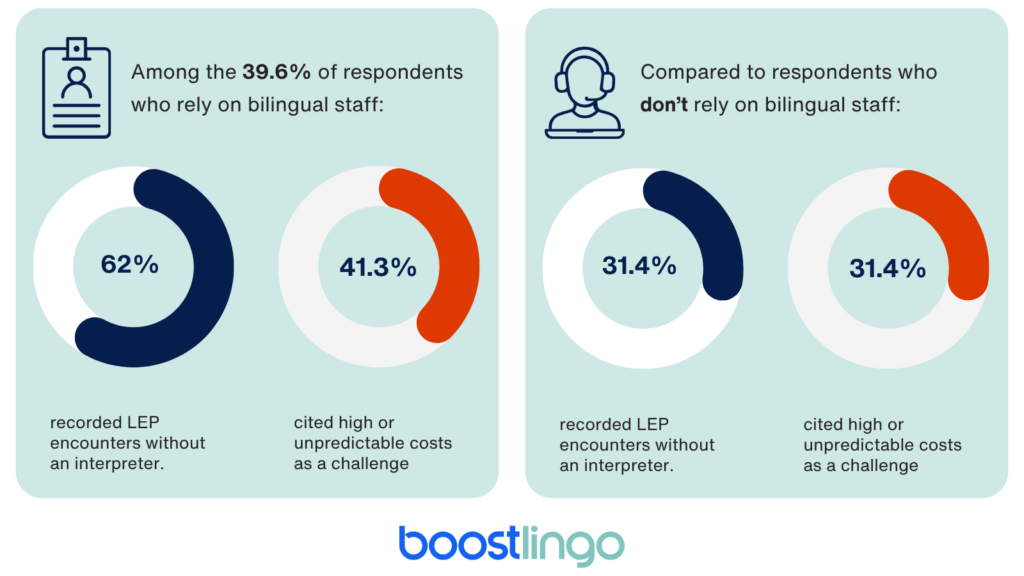
At the same time, organizations relying on bilingual staff reported more access strain: 62% also recorded LEP client encounters without an interpreter when one was needed, compared with 31.4% among non-users.
They also reported greater cost pressure: 41.3% cited high or unpredictable costs as a challenge, compared with 31.4% of non-users, suggesting that ad hoc and informal solutions likely emerge under pressure.
“Bilingual staff are often filling immediate access gaps, but they’re not functioning as a complete operating model. And the data showing higher rates of LEP client encounters without an interpreter in those environments is consistent with what research and policy guidance understand: bilingual ability is not the same as interpreting competency.
The right role for bilingual staff is structured and bounded. They can support communication, reduce friction, and in some cases serve in trained dual-role capacities, but only when there are clear policies, training, and escalation pathways in place.”
Katharine Allen, Director of Language Industry Learning at Boostlingo
Performance Defines Maturity
- Interpreter connection times vary widely, but 52.1% connect under a minute.
- 31.9% cite inconsistent interpreter quality as a top challenge; more than half also say that it impacts their operations.
- 61.8% spend time managing interpreting services, pointing to a persistent coordination burden.
Describing the mix is only part of the picture. The real question is whether these hybrid systems perform well enough to be considered mature.
And by now, it’s becoming clearer that access to multiple interpreting modalities does not, by itself, make a system mature.
True maturity shows up in performance: how quickly interpreters can be reached, how consistently quality holds up, and how much staff effort it still takes to keep the system running.
Interpreting Connection Times
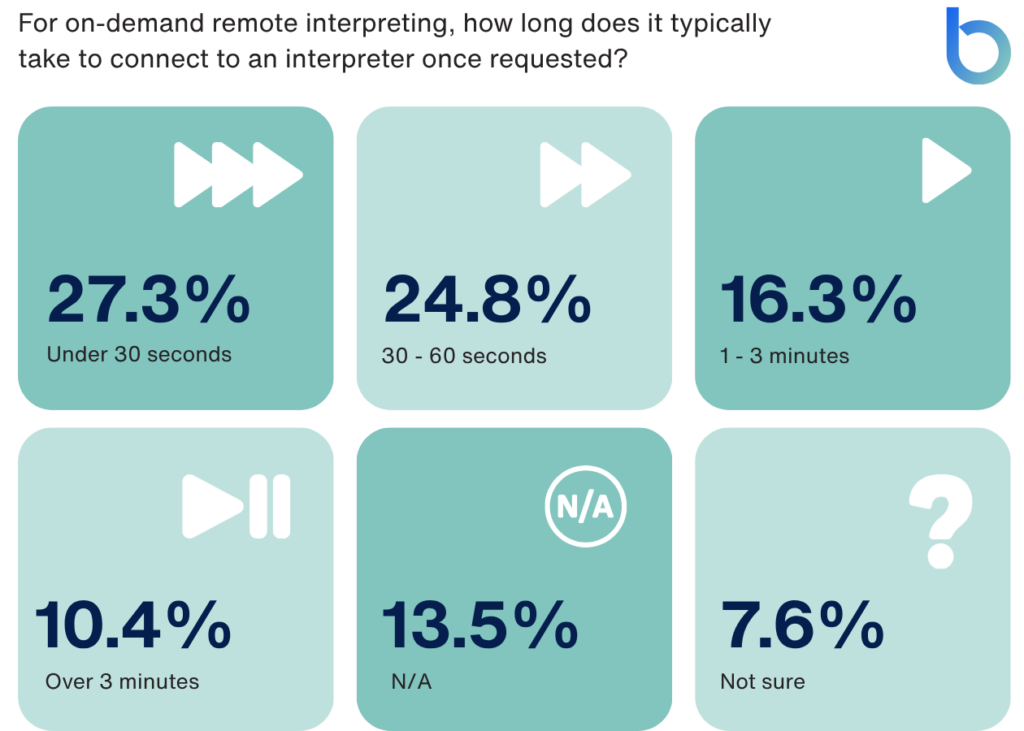
For on-demand remote interpreting:
- 52.1% typically connect to an interpreter in under a minute.
- 16.3% connect between 1 to 3 minutes.
- 10.4% said it takes over 3 minutes.
One of the clearest signals of maturity is speed. And while fast interpreter connection times are now common, they don’t appear to be universal.
In high-volume or time-sensitive environments, even a difference of a few minutes can create real operational bottlenecks.
Among respondents, 78.6% said interpreter wait times affected operations to some degree, including 34.4% who described that impact as moderate to severe.
A smaller but notable group also lacked visibility into performance: 7.6% said they were not sure how long it typically takes to connect to an interpreter once requested. That’s not a large group, but it’s a reminder that speed isn’t just a service metric. It’s also a visibility metric.
What Drives Connection Speed?
Speed is not explained by modality alone. The survey suggests that it is shaped just as much by workflow and infrastructure, or how organizations are set up to access that modality.
Remote-heavy organizations (respondents who reported 51 – 75% or 76 – 100% phone and video interpreting use) performed better on connection time than onsite-heavy ones (respondents who reported 51 – 75% or 76 – 100% onsite interpreting use):
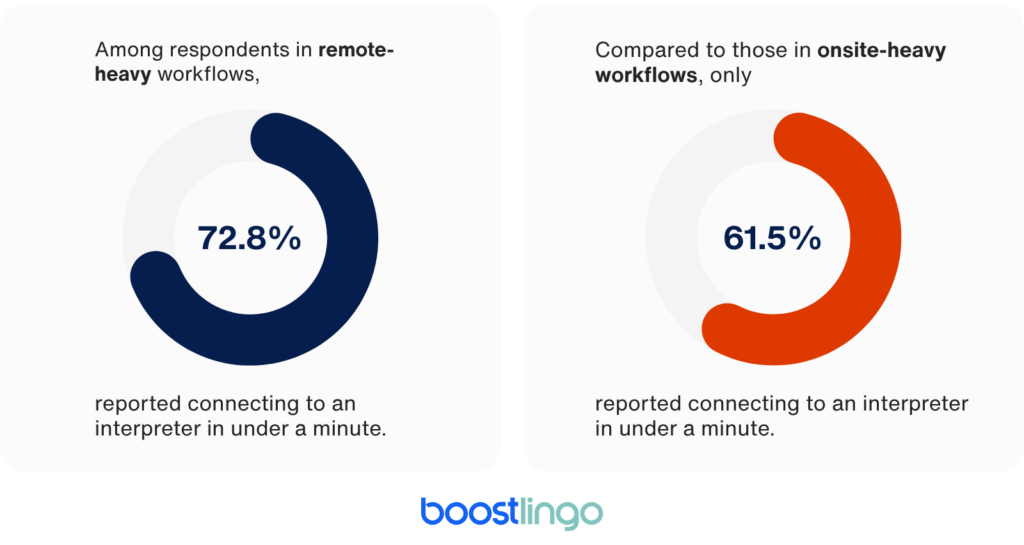
The slower tail is also more pronounced in onsite-heavy models: 20.0% of onsite-heavy respondents reported connection times of over 3 minutes, compared with 8.4% in remote-heavy models.
This suggests that faster performance doesn’t simply depend on whether organizations use remote interpreting, but on whether they have workflows designed to support immediate access.
Routing, interpreter availability, and operational setup appear to matter just as much as the modality itself.
Poor Quality as an Operational Cost
Speed may shape first response, but quality shapes whether the system works well once the connection is made.
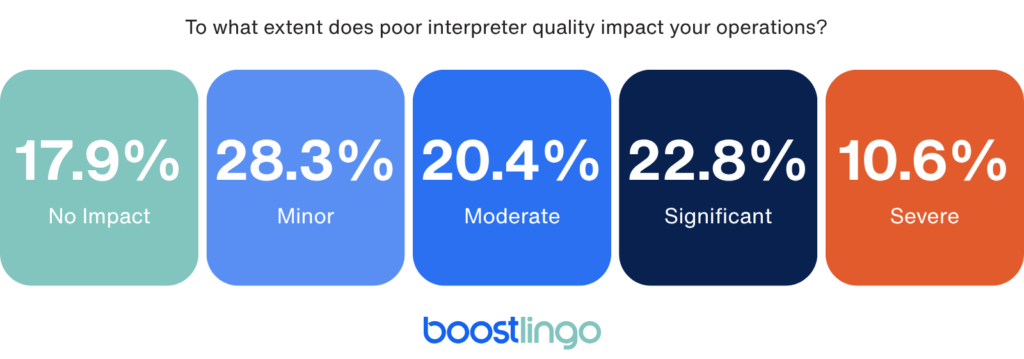
In the survey, 31.9% of respondents selected inconsistent quality as one of the biggest challenges they face today. More broadly, 53.8% said poor interpreter quality has a moderate to severe impact on operations.
That burden rises alongside coordination effort.
Among respondents who said staff time spent managing interpreting was minimal, 39.8% also reported moderate to severe quality impact. Interestingly, 82.4% of those who said staff spend an excessive amount of time managing interpreting also said poor interpreter quality moderately to severely impact their operations.
Poor quality isn’t just a service issue. It also creates downstream friction, rework, and operational drag.
When quality is inconsistent:
- Staff hesitate to trust interpreting services in high-stakes situations
- Encounters take longer due to clarification and repetition
- Documentation becomes more difficult
- Trust in the system erodes
- Staff revert to informal workarounds
Quality problems compound into coordination and cost problems.
The Hidden Cost of Coordination
- 61.8% of respondents say staff spend at least some time coordinating interpreting.
- 25.2% say staff spend a significant or excessive amount of time doing so.
Another important measure of maturity is coordination: how much human effort the system still requires behind the scenes.
Among respondents who answered, “How much staff time is spent coordinating or managing interpreting today?”
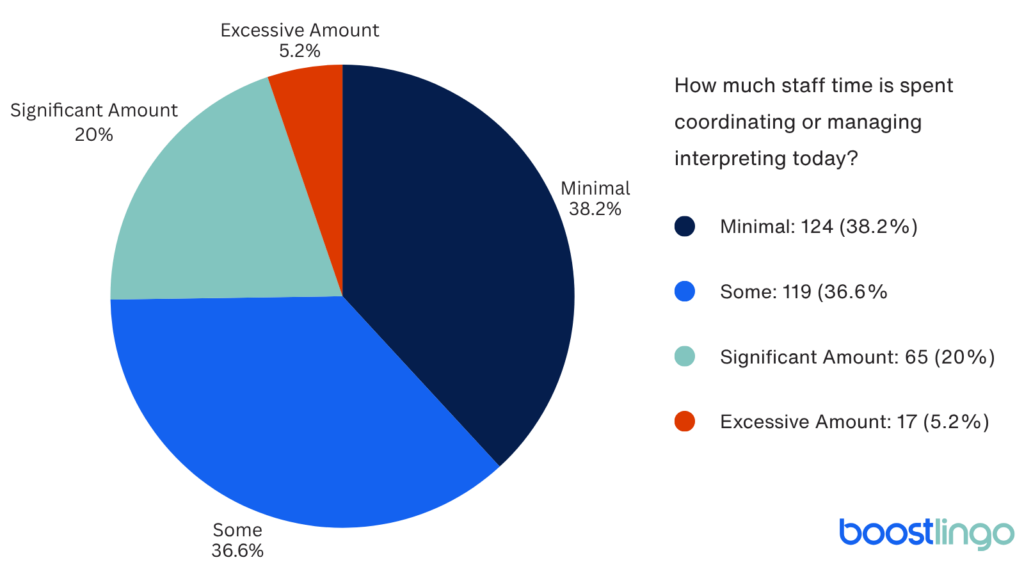
That burden aligns with other signals in the survey, with 31.3% citing manual scheduling, admin, or coordination as a top challenge.
The pattern becomes even clearer when looking at how organizations deliver interpreting. Among those managing three or more modalities, roughly 35–40% report coordination and admin as a top challenge, compared to approximately 15–20% among those using one to two modalities. As modality count increases, so does the number of decisions, handoffs, and failure points.
It’s safe to say that among respondents, coordination isn’t just background noise. It’s an operating cost felt day-to-day by staff that shows up in:
- Manual invoice processing across systems
- Fragmented scheduling across multiple tools
- Inefficient utilization of time minimums
- Manual project management for every assignment
- Lack of integration creating duplicate work
This is the cost of not having an orchestration system.
Taken together, these findings show that maturity depends less on how many modalities an organization has and more on how reliably those modalities perform in practice. That becomes even more important as AI enters the workflow, adding a new layer that must be measured, governed, and integrated.
The AI Interpreting Layer
- ~70% are not using AI yet, but adoption + evaluation is growing.
- Buyers prioritize accuracy (69.9%), risk/compliance (51.5%), and human fallback (35%) when evaluating AI.
- Primary use cases are limited: 34.5% backup, 29% low-risk interactions.
AI is entering interpreting workflows, but within clear limits. So far, adoption looks less like wholesale replacement and more like selective layering: organizations are testing where AI fits, where it does not, and what safeguards are still required.
The Current State of AI Adoption
AI adoption is still early, with almost 70% of respondents reporting they don’t currently use AI interpreting in any capacity.
At the same time, the survey points to a meaningful evaluation pipeline:
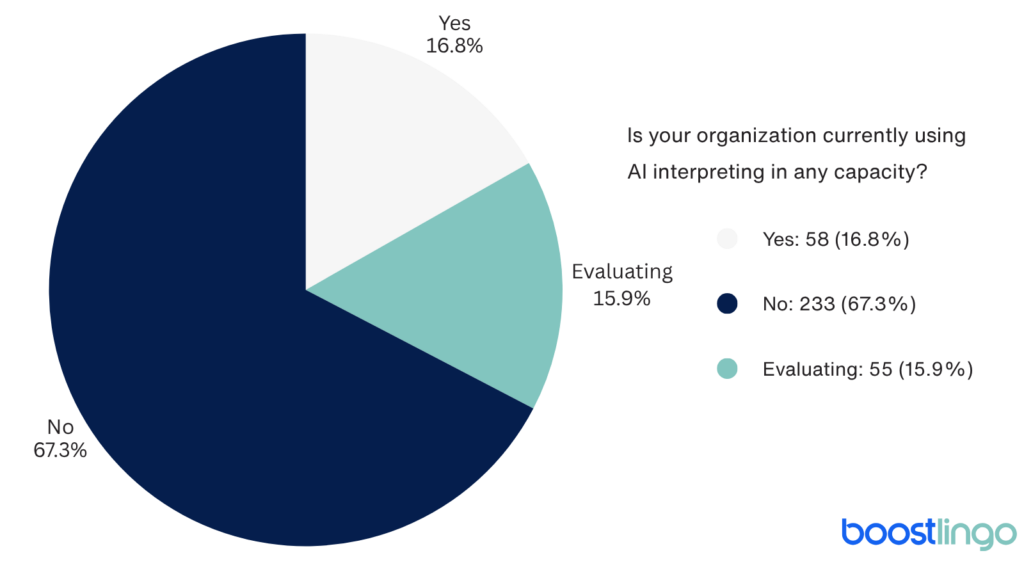
Earlier external research shows a similar pattern:
- In the US Language Access & 2026 Compliance Guide, 41% of language service providers were considering adding AI into interpreting or translation services, while 30.4% were already using it. 28.6% had no plans at the time.
- In the Educational Interpreting Report 2025: Respondents predicted that the interpretation usage for the education industry in 2025 would most likely be VRI (54%) and AI-assisted tools (52%).
Taken together, the signal is clear.
AI in interpreting is moving from initial adoption to cautious experimentation, but still constrained by trust, risk, and limited real-world use cases.
How AI Interpreting is Actually Used
Where AI is in use today, it appears more often as an augmentation layer than as a standalone replacement.
Among respondents who currently use AI interpreting:
- 70.3% also use phone interpreting.
- 51.4% also use video interpreting.
- 51.4% also use bilingual staff.
- 18.5% rely on AI interpreting with no human modality at all.
Almost 1/5 of users reported relying solely on AI interpreting solutions, and considering that ChatGPT launched only four years ago, that’s a fast adoption rate in a regulated space.
Among current AI users who also answered how AI is being used:
- 34.5% use it as backup when human interpreters are unavailable.
- 29% use it for low-risk or routine interactions.
- 10.9% use it for pilot/testing only.
That pattern suggests AI is being added to hybrid systems, not replacing them.
“The next iterations of hybrid AI interpreting systems are rapidly transforming language access in ways that are faster, fairer, and even more human. When advanced language intelligence and skilled interpreters work together, connection becomes more natural, effortless, and truly global.”
Dieter Runge, Co-Founder and VP of Business Development at Boostlingo
This is also reflected in what respondents find acceptable.
The most acceptable AI scenarios were:
- Low-risk use cases (48.8%)
- Routine interactions (29.2%)
Even among non-users of AI, 41.9% still said low-risk AI use is acceptable.
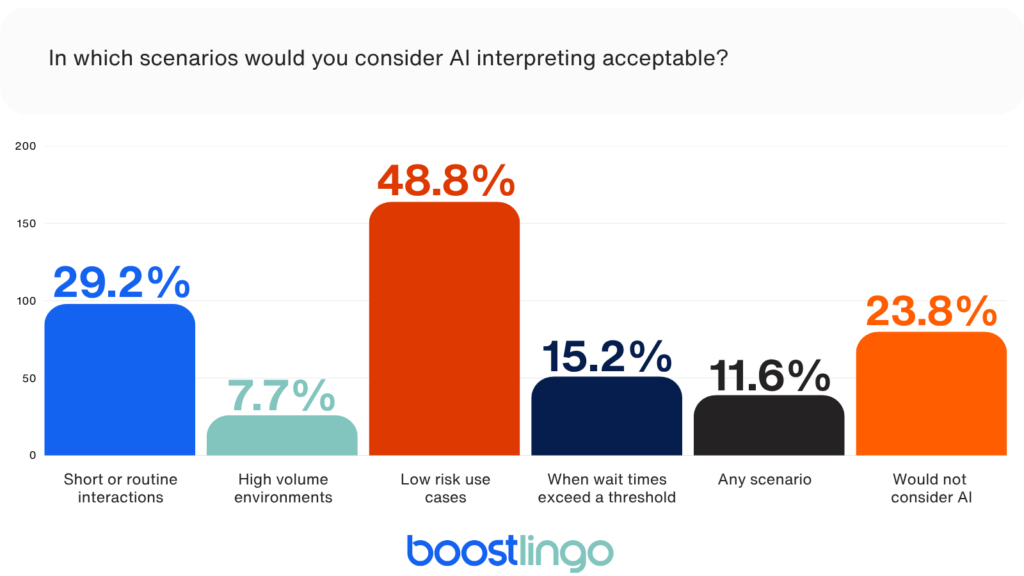
That raises an important question for vendors: How should trust be built when the goal is not full replacement, but safe and reliable support in lower-risk scenarios?
Barriers to Adoption
If adoption is still cautious, the survey suggests the reason is not lack of awareness, but trust, performance, and control.
The most important criteria when evaluating AI interpreting were:
- Accuracy and performance (69.9%)
- Risk and compliance (51.5%)
- Need for human fallback or escalation (35%)
- Cost savings (32.2%)
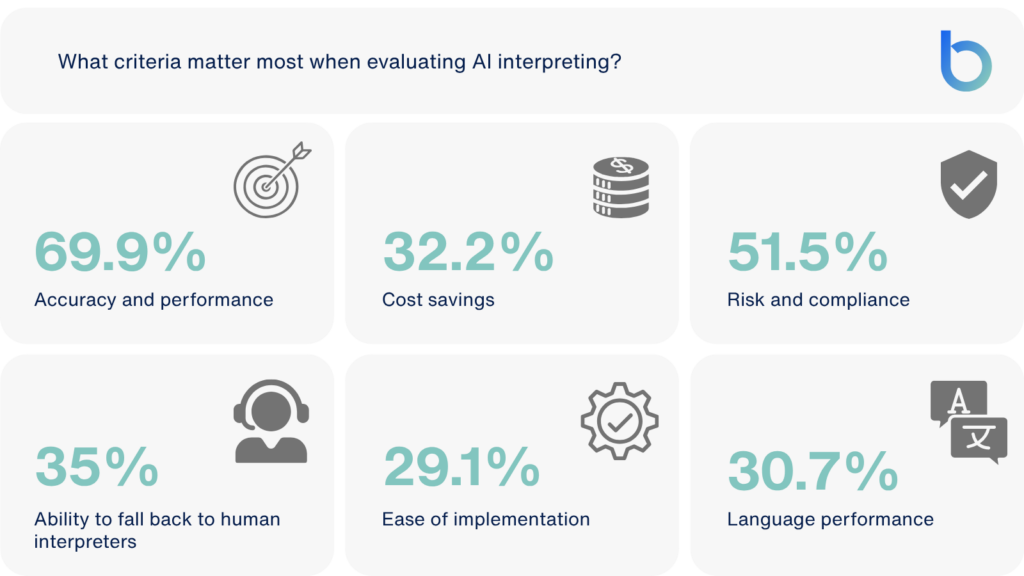
While cost is cited as the most common challenge in interpreting technology overall, AI buyers are prioritizing something different: performance and accuracy. Cost may drive early experimentation, but proven real-world performance will determine what actually scales.
Accuracy and performance are essential to building trust with buyers, who are no longer just asking whether AI works, but how well it performs in real interpreting scenarios.
As AI interpreting continues to evolve, its performance will need to be tested, refined, and retested continuously in transparent, measurable ways across languages, settings, and use cases.
“Buyers should focus less on headline accuracy claims (e.g. “We are 99% accurate.”) and more on how that accuracy is measured.
Strong vendors will be transparent about how they test, the scale and rigor of their data, and how their models perform in real interpreting scenarios, not just generic benchmarks. Just as important is domain expertise – understanding what actually constitutes a high-quality interpretation in practice.”
Ramya Vishwanath, Senior Product Manager, AI Product at Boostlingo
AI-Resistant Segment
Not all resistance to AI should be read as low awareness or lagging adoption. In many cases, it reflects active caution.
23.8% would not consider AI interpreting in any scenario.
16.1% believe AI + human interpreting hybrid models are not acceptable.
Across all segments, most respondents are still non-users of AI. That suggests resistance is not limited to one corner of the market. In many cases, more mature operators may be choosing not to adopt yet because of risk, governance, or workflow fit, not because they are unaware of the technology.
“These adoption signals are less about technical limitations and more about buyer mindset. Organizations are looking for safe, bounded use cases.
My suggestion would be to thoroughly understand where AI fits for your specific organization – a lot of this comes down to understanding your own client population and how they view AI, where it breaks down language barriers or perhaps adds some discomfort and lastly, some good old fashioned trial and error to see where AI fits into your workflows.
Our goal is to give you all the tools and expand language access rather than recommend a specific modality.”
Ramya Vishwanath, Senior Product Manager, AI Product at Boostlingo
The Workforce Question
The longer-term question may be even bigger. If AI absorbs more lower-complexity interactions while pricing pressure continues to rise, the market may not just be changing how interpreting is delivered, but also weakening the workforce pipeline that high-skill interpreting still depends on.
“The promise of AI in interpreting is real: broader access, faster connections, and expanded coverage in settings where human interpreters simply haven’t been available. Hybrid models are not a compromise. They’re the responsible path forward, and integrating AI thoughtfully is a genuine opportunity to close language access gaps that the field has struggled with for years.
Doing that responsibly, though, means we can’t let the human side of that equation erode in the process. If compensation stays flat while AI absorbs the routine interactions that have traditionally served as the entry point for new interpreters, fewer people will enter the profession — and fewer will stay long enough to develop the expertise that high-stakes settings require.
The industry’s call to action is practical: resist the temptation to cut professional development budgets when costs feel high, and instead look for ways to actively build the pipeline — paid internship models, mentorship tracks, partnerships with interpreter training programs. AI should expand what’s possible in language access, not hollow out the workforce infrastructure that makes quality interpreting sustainable.”
Katharine Allen, Director of Language Industry Learning at Boostlingo
The Next Phase: Orchestration
If the last phase of the market was about expanding access to more interpreting channels, the next phase will be about making those channels work together more effectively.
Where the market is heading is becoming clearer:
- From channels to systems
- From inconsistent measurement to observability
- From connectivity to deep workflow integration
- From experimentation to governed AI use
It’s about improving how language access works in practice.
What Orchestrated Interpreting Means
“Orchestration” can’t remain a buzzword. Here’s what it means operationally:
1. Intelligent Routing, Not Manual Selection
The system routes to the right modality based on context, such as language, availability, and encounter needs, without requiring staff to navigate multiple apps or make complex decisions under pressure.
Today: Staff must decide which app to open, which number to call, or which device to use. Each decision point creates friction and delay.
Orchestrated: The system presents one interface. Routing logic happens in the background based on predefined rules and real-time availability.
2. Unified Observability, Not Fragmented Dashboards
Performance metrics (connection time, quality, cost, utilization) are visible across all modalities in one place. Leaders can answer “How is language access performing?” not “How is our VRI vendor performing?”
Today: Each vendor provides separate reports. Connection time data exists for phone but not onsite. Quality metrics are inconsistent across channels.
Orchestrated: One dashboard shows performance across all modalities, with consistent metrics and the ability to drill down by language, department, or use case.
“Today, the biggest gaps are in routing decisions, lack of shared context between AI and human, and no consistent quality measurement across modalities. Systems become reliable when they can route based on complexity and risk, carry context and enforce a consistent quality standard regardless of modality.
What matters next is intelligent orchestration, unified quality measurement, and tight feedback loops that continuously improve accuracy (and outcomes).”
Brian D’Agostino, Co-Founder and Chief Product at Boostlingo
3. Workflow Integration, Not Just Connectivity
Interpreting is embedded in existing clinical/operational workflows (EHR, scheduling, documentation) rather than bolted on through separate logins, devices, or processes.
Today: Staff must leave the EHR to request an interpreter, then manually document the encounter afterward. Interpreting exists as a parallel workflow.
Orchestrated: Interpreter requests flow through existing scheduling systems. Sessions are automatically documented. Performance data feeds into quality dashboards.
4. Governed AI Use, Not Experimentation
AI is deployed with explicit use-case boundaries, quality monitoring, and human escalation paths, not as a cost-cutting measure or “innovation theater.”
Today: AI is tested opportunistically, often without clear criteria for when it’s appropriate or how to escalate when it fails.
Orchestrated: AI use cases are explicitly defined (e.g., “low-risk, routine interactions”). Quality is monitored. Escalation to human interpreters when complexity or risk exceeds thresholds.
5. Predictable Outcomes, Not Variable Performance
Organizations can forecast cost, quality, and access reliability before deployment and measure whether the system delivers on those expectations.
Today: Performance varies unpredictably. Some encounters connect in 30 seconds, others take 5 minutes. Quality is inconsistent. Costs are hard to forecast.
Orchestrated: Service-level agreements are clear and measurable. Performance is consistent. Costs are predictable based on volume and mix.
Why This Matters
The organizations that close this orchestration gap first, whether buyers building it internally or providers delivering it as a platform, will define the next phase of the interpreting technology market.
And once the market can reliably orchestrate multiple modalities, the result is not just better interpreting operations, but stronger access, better experiences, and fewer missed connections where language support matters most.
“The next five years represent a significant opportunity for expansion in language access. Today, more than half of the market experiences unmet interpreting demand, meaning individuals are unable to access services due to limited interpreter availability, lack of access tools, or cost barriers. This gap defines the market’s greatest area for growth.
AI-driven interpreting has the potential to meaningfully reduce these barriers by lowering costs and expanding access, particularly for lower-risk interactions. At the same time, human interpreting will continue to grow as remote modalities such as VRI and OPI improve with advancements in bandwidth, connectivity, and platform reliability.
Quality assurance will play a critical role in this evolution. As technology enables faster connections to interpreters, it will also enable better matching – connecting users not just to available linguists, but to qualified professionals with the appropriate domain expertise. This will improve outcomes and build greater trust in language services overall.
Looking ahead, we expect a market where technological innovation significantly reduces unmet demand. The combination of AI, improved remote delivery, and more intelligent orchestration will expand access to language services at a scale that has not previously been possible.”
Bryan Forrester, Co-Founder and Chief Executive Officer at Boostlingo
Report Methodology
This report is based on a 2026 survey of more than 370 stakeholders across the interpreting ecosystem, including both buyers and providers.
The majority of responses were not from Boostlingo customers, representing a broader industry segment.
The sample spans multiple sectors, led by:
- Healthcare (38.8%)
- Language services (21.0%)
- Nonprofit organizations (15.1%)
And organization size, spanning:
- 100 employees (63.3%)
- 100 – 499 employees (22.3%)
- 500+ employees (14.5%)
The report is designed to reflect how interpreting is operated today across modalities, devices, and workflows rather than preferences alone.
For access to the full dataset or report visuals, email [email protected]. If you cite or share this data, we kindly ask that you link back to the original report.
References
- Crawford, Kendall. “Amid Shortages, Ohio Supreme Court Amends Requirements for Court Interpreters.” The Ohio Newsroom, December 8, 2025.
- Deaf Services Unlimited. “ASL Interpreter Shortage: Your Questions Answered.” Deaf Services Unlimited, July 6, 2023.
- Hsieh, Elaine. “Not Just ‘Getting By’: Factors Influencing Providers’ Choice of Interpreters in Healthcare.” PubMed, October 23, 2014. PMID: 25338731.
- Cevallos, Jenny, BS; Lee, Carmen, MD, MAS; and Bongiovanni, Tasce, MD, MPP, MHS. “Use of Professional Interpreters for Patients With Limited English Proficiency Undergoing Surgery.” JAMA Network Open, February 6, 2024.
See how Boostlingo can help
Use interpreting technology to help you easily communicate across language barriers. Lower costs, improve quality, and simplify management with a single platform.