Explore

While writing the State of Interpreting Report 2026, one finding stood out: not all organizations rely on interpreting in the same way.
Some use on-site, phone, and video interpreting together across high-volume environments.
Others primarily rely on remote interpreting or bilingual staff to fill gaps.
A smaller group is also testing AI interpretation.
That matters because each “model” has its own strengths, risks, and areas for improvement. More interpreting options do not automatically create a stronger language access program. Without strong systems and processes, even mature programs can be difficult to coordinate.
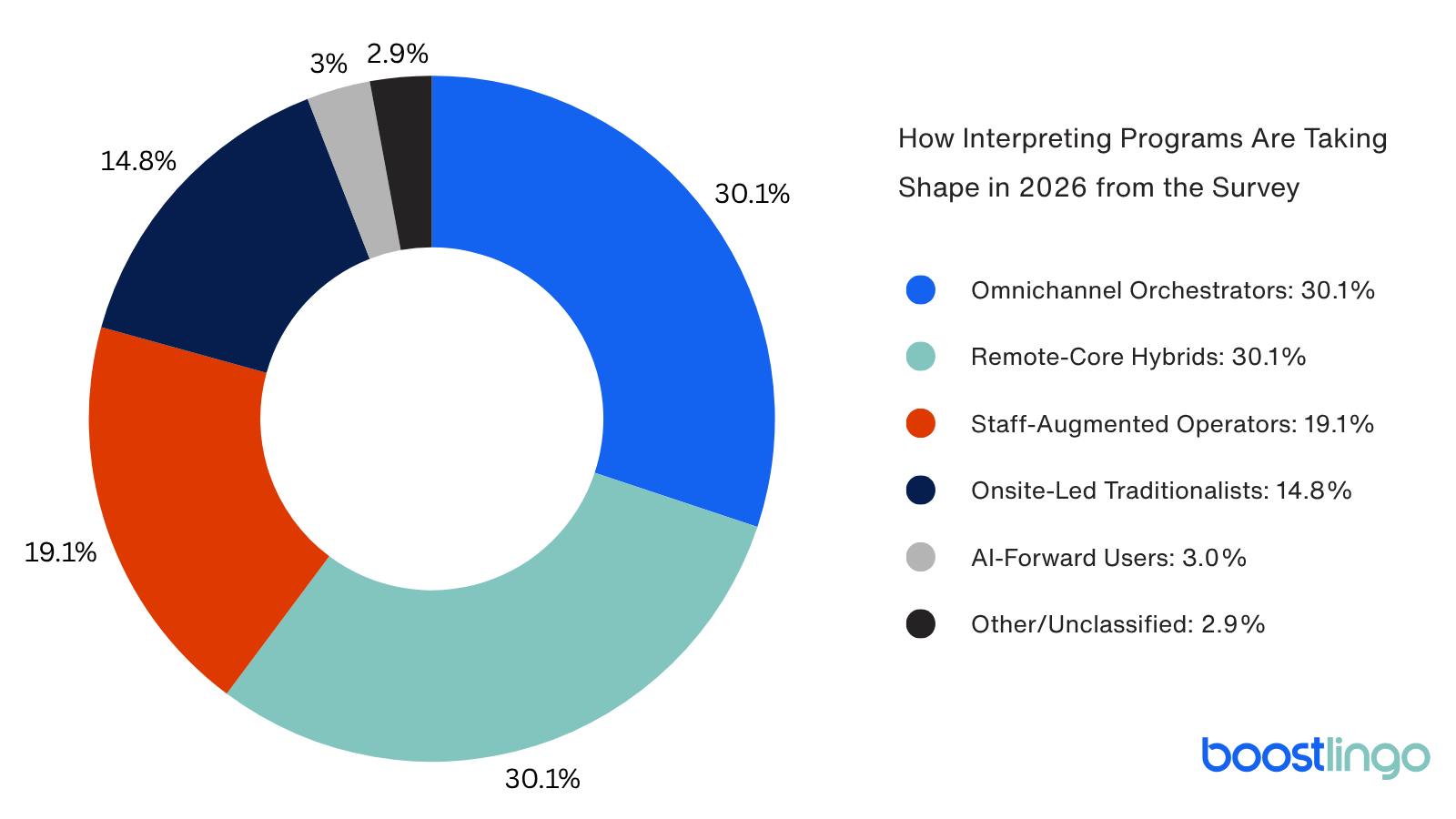
The report identified five major behavioral segments that accounted for the majority of respondents. These segments are not exhaustive, and a small share of respondents did not fit cleanly into one of the five groups.
Omnichannel Orchestrators (30.1%)
Omnichannel Orchestrators represent 30.1% of respondents and run the most complex interpreting programs, combining on-site, phone, and video interpreting within a single workflow. Many also use bilingual staff and are using or evaluating AI.
These organizations need to cover a lot of ground. In the survey, 53.6% needed interpreting multiple times per day, and 26.8% encountered 76+ languages.
With several options available, staff can connect people with language support in more ways. That can help when needs are urgent, remote, in person, or less common by language.
Strengths
This model gives teams flexibility across channels, settings, and languages.
- 58.5% said their current setup scales well.
- 51% reported systems integration.
Challenges
More options can make the program harder to manage. Omnichannel Orchestrators reported challenges with:
- Inconsistent quality
- Manual scheduling or administrative work
- Limited language availability
- Difficulty coordinating across channels
What to Improve
For this group, the priority is not adding another way to connect to interpreters. It is making the full program easier to manage.
Focus on:
- Seeing what is happening across all interpreting channels
- Creating clear rules for when to use each option
- Standardizing quality controls and reporting
Ask yourself: Are we managing interpreting as a strategic operational function, or just offering multiple interpreting options?
Remote-Core Hybrids (30.1%)
Remote-Core Hybrids represent 30.1% of respondents and rely mainly on over-the-phone interpreting (OPI) and video remote interpreting (VRI), with little to no on-site interpreting.
This model is designed for speed and scale. For many organizations, this is the promise of remote interpreting: faster access, broader coverage, and less manual coordination than on-site-heavy programs.
Strengths
This model can help teams move quickly and efficiently.
- 61.8% connected to an interpreter within 60 seconds.
- 66.3% said their current interpreting solutions scaled with their needs.
- Only 14.3% reported high staff-time burden.
Challenges
Remote-first does not always mean friction-free. These organizations still reported challenges with:
- Interpreter quality
- Manual scheduling and admin work
- Limited language coverage
- Inconsistent workflows across teams
What to Improve
For this group, the priority is making remote interpreting more consistent.
Focus on:
- Standardizing how staff access phone and video interpreting
- Clarifying when to use each remote option
- Making documentation and escalation steps easy to follow
Ask yourself: Is remote interpreting easy and consistent across the organization, or does the experience depend on department, location, or staff familiarity?
Staff-Augmented Operators (19.1%)
Staff-Augmented Operators represent 19.1% of respondents and rely heavily on bilingual staff to fill language access gaps, often alongside phone and video interpreting. Their use of on-site and AI interpreting is limited.
This model can feel practical. Bilingual staff are nearby, trusted by colleagues, and able to help in the moment. It’s easy to see why teams lean on them, since waiting too long for an interpreter can affect service, care, or the customer experience.
The issue isn’t bilingual staff. It’s relying on them without enough structure.
Strengths
This model can help teams respond quickly.
- 65.6% said their current setup scales reasonably well.
- Bilingual staff can help fill immediate communication gaps.
- Phone and video interpreting can provide additional support when available.
Challenges
Without clear guardrails, this model can create risk. Common risks for this model include:
- More encounters with people with limited English proficiency without an interpreter, compared with organizations that do not rely on bilingual staff (62.0% vs. 31.4%)
- Inconsistent documentation
- Compliance risk, including Title VI language access obligations
- Unclear escalation paths
- Bilingual staff are being asked to interpret beyond their role or training
What to Improve
For this group, the biggest priority is creating clear rules. Focus on:
- Defining when bilingual staff can support communication
- Clarifying when a professional interpreter is required
- Documenting encounters consistently
- Creating clear paths for staff to connect to professional interpreters
Ask yourself: Are bilingual staff part of a documented language access strategy, or are they being used as an informal workaround?
Onsite-Led Traditionalists (14.8%)
Onsite-Led Traditionalists represent 14.8% of respondents and keep on-site interpreting at the center of their language access program, with some support from OPI and VRI.
In-person support can be valuable for sensitive, complex, or high-trust conversations. But when a program depends too heavily on manual scheduling and coordination, it can become harder to scale.
Strengths
This model supports situations where in-person communication matters most.
- On-site interpreters can be valuable for complex or sensitive conversations.
- This model can work well for scheduled or predictable needs.
- Some organizations are already exploring newer options, with 24% using or evaluating AI.
Challenges
This model showed signs of pressure:
- Only 29.4% connected to an interpreter in under 60 seconds.
- 44% reported significant or excess staff-time burden.
- 41.2% cited high or unpredictable costs as a top challenge.
These issues can make urgent needs harder to support and costs harder to predict.
What to Improve
The goal is not to move away from on-site interpreting. It is to modernize the workflows around it.
Focus on:
- Reducing manual interpreter scheduling
- Adding remote options for urgent or lower-complexity needs
- Improving visibility into demand and cost
- Making it easier for staff to access the right support without extra steps
Ask yourself: Are we using on-site interpreting where it adds the most value, or are we relying on it because our workflows have not evolved?
AI-Forward Users (3.0%)
AI-Forward Users represent 3.0% of respondents and are actively testing or using AI interpreting to expand coverage, reduce costs, or fill access gaps.
This was the smallest group in the survey, so it should be read as an early signal rather than a broad market conclusion. Still, the pattern is important: some organizations are already experimenting with AI as a primary part of their interpreting program.
AI can help in routine, low-risk moments where speed and availability matter. But AI does not remove the need for a clear operating model. It makes that need even more important.
Strengths
This group shows where early AI experimentation is happening.
- 90.9% reported active AI use.
- AI may help expand access for routine, low-risk interactions.
- AI can help fill coverage gaps when human interpreters are impractical or not immediately available.
Challenges
These organizations did not appear to have fully mature AI workflows.
- 100% of those who described their current interpreting experience said it was frictional.
- 45.5% struggled with high or unpredictable costs.
- Their AI use appeared more pain-driven than mature.
- AI can improve speed, scale, and cost efficiency in the right situations. But without clear rules, it can create new risks around privacy, quality, documentation, and appropriate use.
What to Improve
For this group, the priority is building rules before scaling AI.
Focus on:
- Defining when AI interpretation is appropriate.
- Setting clear quality and risk controls.
- Keeping professional human interpreters available for complex or high-stakes conversations.
- Creating safe escalation paths when AI is not the right fit.
Ask yourself: Do we have clear rules for when AI interpretation is appropriate, and a safe path to human support when it is not?
Your Program May Not Fit One Segment
Most interpreting programs do not fit neatly into a single segment, and the same organization may operate differently across departments, locations, or use cases.
That is the point. The goal isn’t to pick one label and stick to it. The goal is to understand where your interpreting operation is working, where it is breaking down, and what needs to improve first.
To do that, start with a few questions:
- Are we adding interpreting channels faster than we are coordinating them?
- Do staff know when to use on-site, phone, video, bilingual staff, AI, or professional human interpreters?
- Where do delays, gaps, or quality issues show up most often?
- Do we have clear escalation paths when AI or bilingual staff are not the right fit?
Improving language access starts with understanding how interpreting actually works inside your organization. Once leaders know that, they can make better decisions about staffing, scheduling, integrations, reporting, AI, and quality controls.
The strongest language access programs are not the ones with the most options. They are the ones with the clearest operating model.
Read the Full Report
Explore the full State of Interpreting Report 2026 to see how interpreting programs are evolving, where operational gaps are showing up, and what the data reveals about the future of language access.