Explore

Language access has always been about one thing: helping people understand each other and achieve their communication goals. The tools we use to get there have evolved: from in-person interpreters to telephone and video remote interpreting to AI-assisted options now entering the market. Each shift has brought new capabilities and new expectations for working effectively with the technology.
AI interpreting is the latest of those shifts, and it’s generating real questions.
How does it work?
When does it work well?
What does it ask of the people using it?
This article offers practical answers, drawn from what we’ve learned at Boostlingo as we’ve developed and tested our AI Interpreter alongside the human interpreting services at the core of what we do.
What AI Interpreting Does and Does Not Do
In a live session, an AI interpreting system captures spoken language, processes it, and delivers an interpretation in the target language in near real time. Today’s systems are primarily focused on accurately interpreting speech.
More sophisticated tools are beginning to incorporate basic conversation management features, including detecting when a speaker has finished, verifying that key numbers or terms were captured correctly, and improving how the system handles the natural messiness of live conversation.
These capabilities will continue to mature. Even so, the gap between what AI can manage and what a professional human interpreter does in the room remains significant. Current AI systems do not:
- Manage the flow and structure of a complex conversation
- Infer implied meaning or cultural context
- Flag confusion or ask for clarification unprompted
- Take action on your behalf
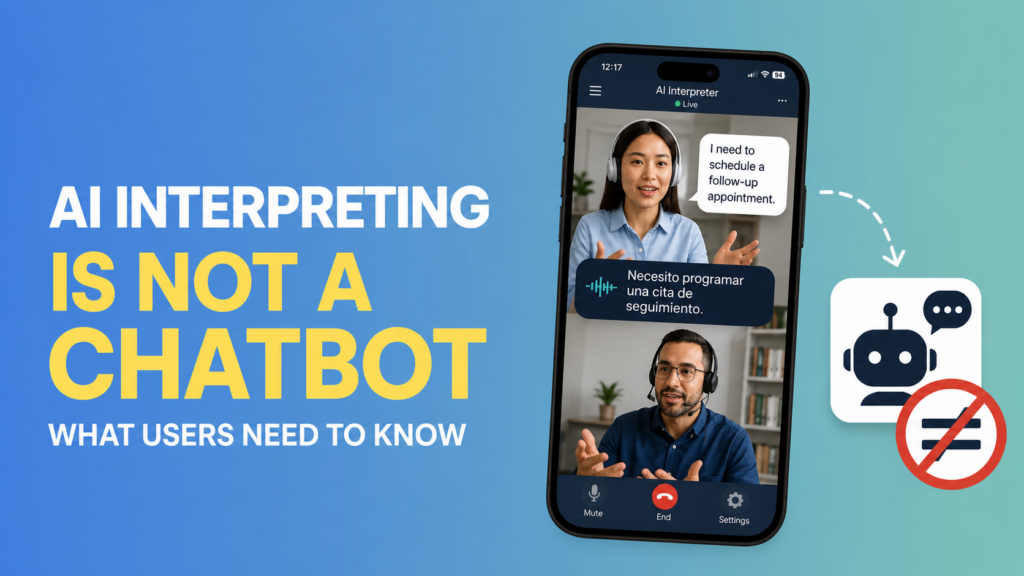
That last point matters a lot. Many of us are used to engaging with AI chatbots that act as our agents.
It’s not uncommon for users of AI interpreting tools to say things like, “Interpreter, can you give me a summary of what was just said,” or “Interpreter, why isn’t this working?”, expecting the system to start problem-solving as an assistant. It won’t. Or if it tries to, it’s escaped its role boundaries.
Whatever you say is interpreted into the other language. The system is a language tool, not an agent or assistant, and understanding that distinction is the foundation of using it well.
What a Successful Session Looks Like
Boostlingo’s Senior Product Manager Ramya Vishwanath puts it well: the goal of an AI interpreting session is for all parties to achieve mutual understanding and accomplish what they came to the conversation to do.
This corrects a common misconception: that a good session is one in which the interpreter, whether human or AI, disappears completely.
Interpreters are never truly invisible. Anyone who has worked with a professional human interpreter knows that a third party is present. What professional interpreters do is earn trust and operate with minimal disruption, so that parties can engage with each other while the communication work happens around them.
A successful session, concretely, is one where:
- Communication moves forward, and both parties leave with clarity
- The interpreted output makes sense in context
- No harm results from misunderstanding, incomplete output, or misplaced assumptions about what was said
- When something goes wrong, participants can recover and keep going
AI Interpreting Is Software, Treat It Like One
Think about the last time you booked travel online instead of calling an airline to speak to a human agent. You gained a powerful tool. More options, immediate results, available anytime. But you also took on work the agent used to handle: comparing fares, reading the fine print, and managing changes when something went wrong.
The tool didn’t fail you. It required a different kind of engagement.
AI interpreting works the same way.
With a skilled human interpreter, much of the conversation management happens in the background. The interpreter ensures everything is communicated, slows a fast-talking speaker, asks for clarification when something is unclear, and resets the exchange when it goes off track. Users will notice this work, but a good interpreter does it without interrupting the flow.
With AI interpreting, that work falls to the users themselves. The conditions you create, before and during the session, directly shape what you get out of it.
Strong sessions share a few common characteristics:
- Clean audio and a stable internet connection
- One speaker at a time
- Clear pacing, with deliberate pauses between turns
- Short, focused turns covering one idea at a time
- Willingness to stop and restate when something breaks down
AI interpreting sessions that struggle tend to involve
- Background noise or poor audio
- Overlapping speech
- Rapid delivery or long, complex turns
- Multiple ideas packed into a single statement
- Participants pushing through confusion rather than pausing to reset
Steps to Set Up for Success
A few straightforward steps before the first word is spoken can make a meaningful difference:
- Choose a quiet environment. Background noise is the single biggest obstacle to accurate AI interpreting.
- Check your internet connection. Dropped audio and delays compound quickly in a live session.
- Position microphones well. Clear input will improve output.
- Brief your participants. People who understand the purpose of the conversation and know they’ll need to take turns tend to communicate more clearly from the start.
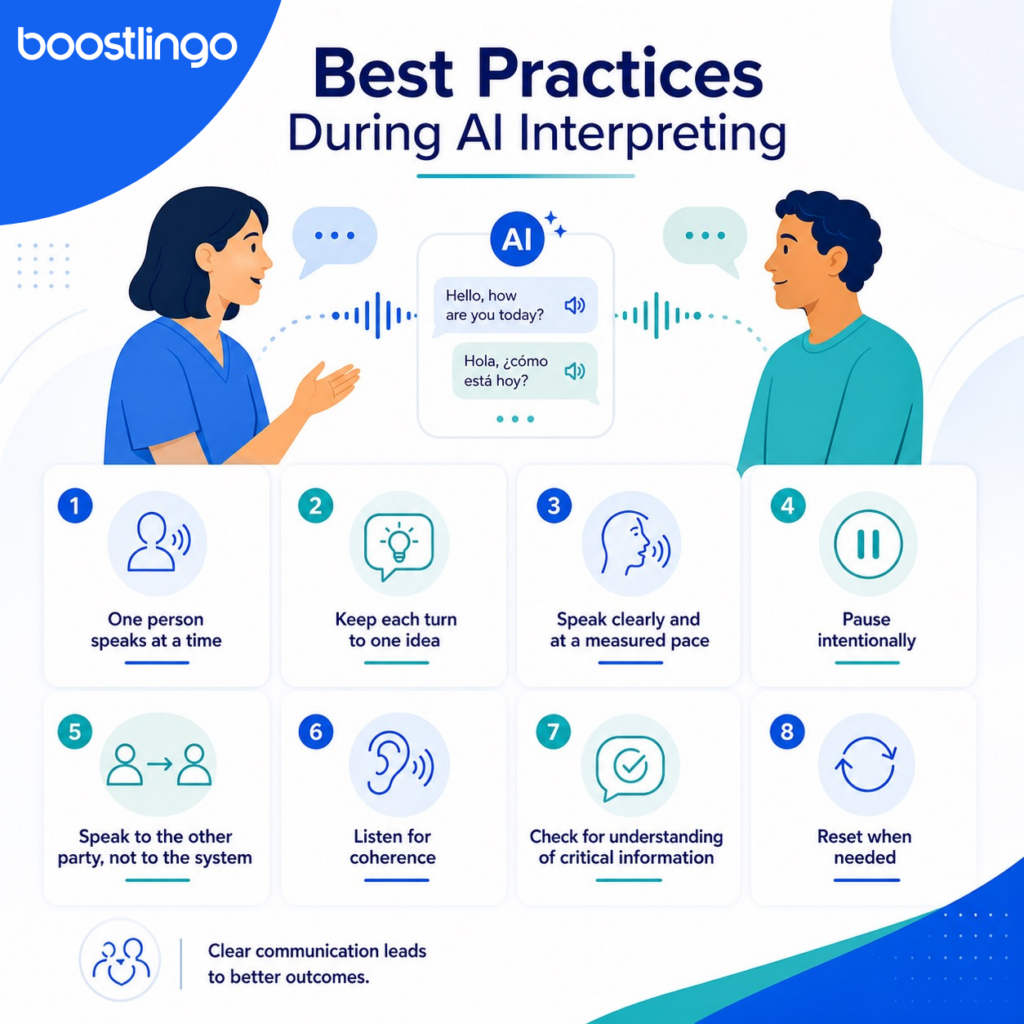
Best Practices During AI Interpreting
1. One person speaks at a time
The AI will generally follow the loudest voice, but two people talking simultaneously creates problems that no system handles gracefully.
2. Keep each turn to one idea
Stacking questions or covering multiple points in a single turn makes it harder for the system to produce accurate, coherent output.
3. Speak clearly and at a measured pace
Not unnaturally slow, just without rushing.
4. Pause intentionally
Today’s AI interpreting systems detect pauses as signals that a speaker has finished. A long mid-sentence pause can prompt the system to begin interpreting before the thought is complete. Short, focused turns with a deliberate pause at the end give the system clean cues to work with.
5. Speak to the other party, not to the system
With a human interpreter, a skilled professional will redirect a provider who starts addressing the interpreter instead of the patient, such as “Can you ask her…” or “Tell him that…”, back to direct speech. AI interpreting has no such intervention. Whatever you say will be interpreted literally, so address your words to the person you’re communicating with.
6. Listen for coherence
Even without understanding the other language, you can usually tell whether a reply fits the question. If something seems off, restate from the beginning rather than pressing forward.
7. Check for understanding of critical information
This is a practice many providers are already trained to do with their patients and clients, and it’s equally important with AI. If you’ve communicated something important, ask the other party to reflect it back. A simple “Can you tell me what you understand your treatment plan to be?” or “Can you repeat back the time and date of our next session?” can quickly surface whether the key information landed. Just as when you provide a service directly in English, don’t assume that because something was said, it was received and understood. Check to make sure!
8. Reset when needed
When a session loses its thread, stopping and restarting from a clean starting point almost always works better than continuing into confusion.
When AI Interpreting Isn’t the Right Tool
Using any tool well means knowing its limits. AI interpreting isn’t a good fit for every situation, and organizations deploying it should carefully consider context.
Consider escalating to a human interpreter when:
- Multiple speakers are likely to overlap
- The conversation carries significant emotional weight
- Cultural nuance or context-dependent meaning is central to the exchange
- A misinterpretation could cause real harm in certain clinical encounters, legal proceedings, or crisis situations
It’s important to understand where an AI tool performs best and where human judgment, adaptability, and accountability remain essential. At Boostlingo, AI interpreting is one option within a broader platform, the right choice in some situations, and not in others. Knowing which is which is part of responsible deployment. The SAFE AI Interpreting Solutions Evaluation Toolkit provides a rigorous framework for organizations making these assessments.
A Word on Accuracy
AI is not perfect. Mistakes, omissions, and hallucinations remain possible, and no AI interpreting vendor should suggest otherwise. Boostlingo has conducted rigorous accuracy testing using real medical audio and complex scenarios, measuring hundreds of utterances against expert reference translations, because real interpreting conditions are far messier than any controlled demo.
That testing isn’t a one-time exercise. Boostlingo conducts continuous, ongoing human evaluation of our AI tools across languages and settings, using those findings both to monitor real-world performance and to drive the improvements that shape each successive version of the product.
The SAFE AI Task Force’s evaluation guidance sets a higher bar for how the industry should assess these tools, and it’s worth reviewing before making any deployment decisions. The goal isn’t perfection. It’s responsible use: deploying AI interpreting in settings where it can serve people well, being honest about limitations, and equipping users with the knowledge to keep communication on track when it needs intervention.
Trust in a communication tool, human or AI, is built the same way: consistent performance, transparency about what it can and can’t do, and the organizational practices that support it.
The Bottom Line
AI interpreting can meaningfully expand language access, reduce wait times, and support communication in settings where human interpreters aren’t available or where demand exceeds supply. It can also handle repetitive, scripted interactions, with AI reliably managing routine communication and appropriate guardrails in place. This includes appointment reminders, intake screening, and straightforward informational exchanges, freeing qualified human interpreters for the higher-stakes conversations that genuinely require their judgment, cultural fluency, and professional accountability.
Better outcomes don’t come from better technology alone.
They come from users who understand what they’re working with, organizations that deploy it in the right contexts, and a clear-eyed commitment to the goal that has always defined good language access work: meaningful mutual understanding.
For a comprehensive look at what to evaluate before selecting an AI interpreting solution, Boostlingo’s Buyers Guide for AI Interpreting is a useful starting point.